
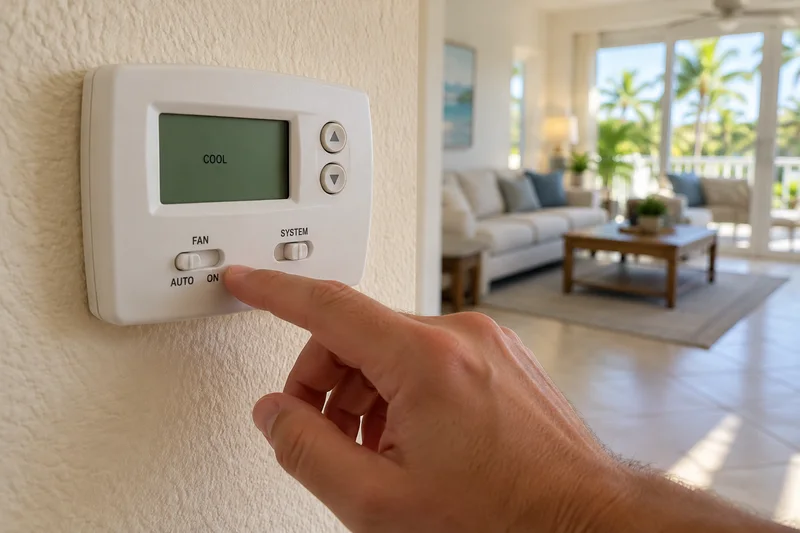
Set the fan to AUTO, not continuous ON
In a South Florida home with a conventional central air-conditioning system, AUTO is generally the better everyday fan setting for humidity control. ON keeps air moving, but moving air is not the same as removing moisture. That distinction matters when the house feels cool yet damp.
This advice is about the thermostat's FAN control, not its heating-and-cooling mode. You can leave the system mode on COOL and set the fan to AUTO. Choosing AUTO under the fan menu does not mean the thermostat will automatically switch between heating and cooling.
- FAN AUTO: The indoor blower generally runs when heating or cooling is needed, then stops according to the equipment's control sequence.
- FAN ON: The indoor blower runs continuously, including between cooling cycles. The compressor still cycles; ON does not mean continuous cooling.
- CIRCULATE or scheduled fan operation: The blower may run between cooling calls, even when the main fan setting appears automatic. Check these additional settings if humidity is a concern.
A short, manufacturer-programmed blower delay can be normal. Do not change installer settings or disconnect equipment to force the fan to stop.
What happens to water on the cooling coil
While the compressor is operating, the indoor evaporator coil becomes cold. Moisture from the air condenses on that coil, collects in the drain pan and leaves through the condensate drain. This is how an air conditioner removes water vapor while it cools.
At the end of a cooling cycle, some water remains on the coil and nearby wet surfaces. If the blower keeps pushing air across them after the compressor stops, some of that moisture can evaporate back into the airstream. The system may return part of the water it just removed to the occupied rooms.
AUTO reduces that unnecessary off-cycle airflow. It does not instantly dry the coil, guarantee drainage or eliminate every source of humidity. It simply avoids running the blower continuously across a wet coil when the refrigeration system is no longer actively cooling it.
The amount of moisture returned depends on the equipment, controls and operating conditions. There is no universal humidity increase or guaranteed savings figure that applies to every home.
Why a cool Florida home can still feel damp
A thermostat's temperature reading does not tell the whole moisture story. On a mild, humid day, a home may need little cooling even though moisture continues entering through normal occupancy, ventilation or air leaks. Short cooling calls leave more time between cycles when a continuously running fan can work against dehumidification.
Use a separate hygrometer to track indoor relative humidity rather than relying on how cold the house feels. EPA guidance is to keep indoor relative humidity below 60%. A reading below that level is not a guarantee against mold: a leak, wet wall cavity or cold surface can still create a local moisture problem.
Persistent dampness, recurring musty odors, condensation or spotting near supply grilles deserve attention. These observations do not prove that the fan setting caused mold. They are reasons to investigate moisture conditions instead of simply lowering the thermostat.
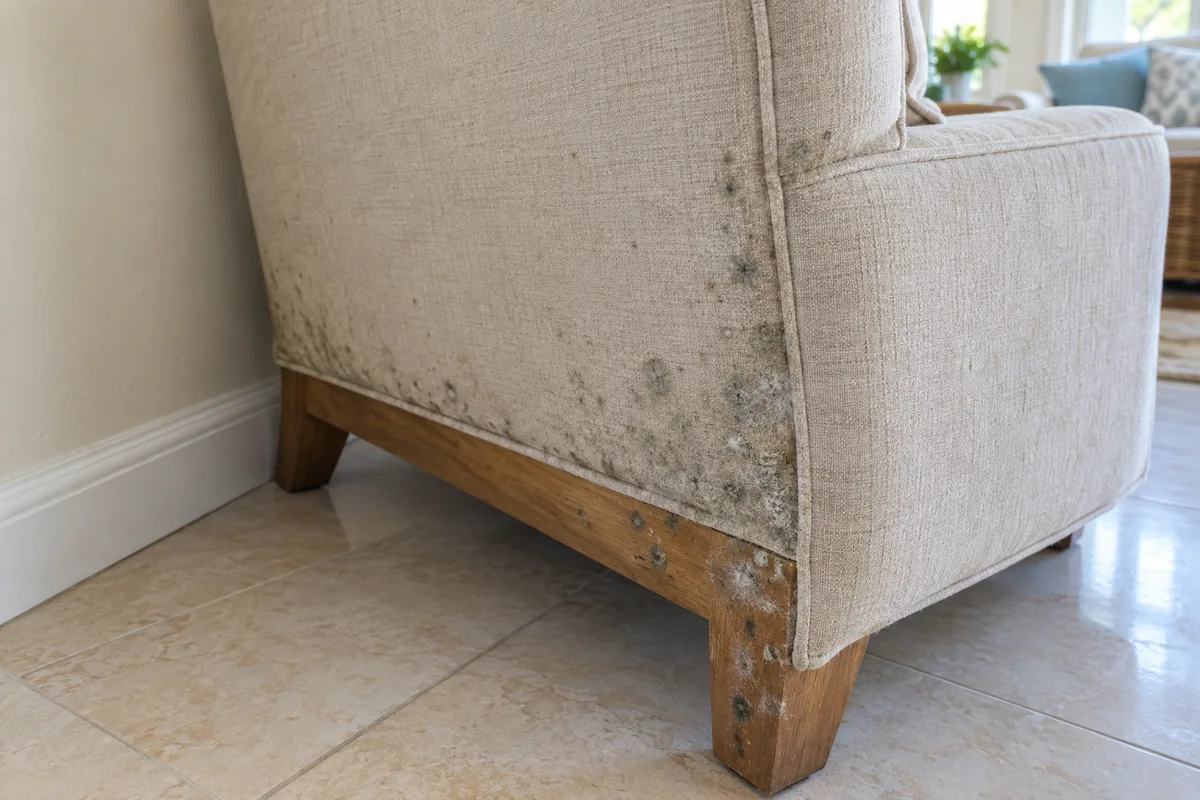
Prolonged high humidity can also support mold growth on furniture, including upholstery, fabric backing and unfinished wood. Areas behind furniture may stay damp where air movement is limited. A leak or flood is not always required. Mold-like spotting on a chair does not establish the cause by itself; check humidity, nearby surfaces and other moisture sources.
Running the blower longer can also extend the time that a leaky return draws air from an attic, garage or equipment closet. If your air handler is beside the garage, see our article on garage A/C closets and return-air leaks. AUTO does not repair those openings.
Check the setting, then check the house
Start with a simple adjustment and observation, not a major equipment purchase. For a conventional system without a specific continuous-fan requirement:
- Find the FAN menu. Select AUTO rather than ON. Look separately for circulation schedules or minimum fan-runtime options that may keep the blower operating between cooling cycles.
- Track humidity under ordinary living conditions. Place the hygrometer away from a supply vent, direct sunlight and shower steam. Compare readings over several days and note whether cooling was running.
- Look for water without opening equipment. Visible overflow, a damp air-handler platform or water staining calls for service. Do not open energized cabinets or disturb suspect growth.
- Keep normal maintenance current. Follow the manufacturer's filter instructions, keep returns unobstructed and have an HVAC contractor check drainage, airflow and cooling performance when needed.
- Control other moisture sources. Use bathroom exhaust and an externally vented kitchen hood appropriately, repair leaks and avoid leaving windows open while cooling.
Do not use a lower temperature as the only response to high humidity. If the home stays damp on AUTO, an HVAC professional should evaluate equipment sizing, cycling, controls and ventilation. A dedicated dehumidifier may be appropriate, but the cause should be identified first.
When continuous airflow needs a different approach
AUTO is a practical default, not a rule for every installation. Some variable-speed systems, integrated dehumidifiers, ventilation arrangements and filtration setups have specific blower requirements. A ductless unit's AUTO fan-speed setting can also behave differently from a central thermostat's AUTO/ON control.
If continuous airflow was deliberately specified, ask the installer how that sequence manages humidity between cooling cycles. Follow the equipment documentation and have the contractor review the configuration. Do not disable required ventilation or override a designed control strategy based only on general advice.
Switching to AUTO is not mold remediation. It cannot dry concealed water damage, remove existing growth or establish whether a stained surface contains mold. A moisture-focused mold assessment can help distinguish a building leak from condensation or an HVAC-related moisture pattern, while an HVAC contractor handles mechanical diagnosis and repairs.
The takeaway: For a conventional South Florida central A/C system, leave the fan on AUTO unless the equipment's design calls for something different. Measure humidity and investigate persistent dampness rather than assuming that more airflow means a drier home.
If musty odors, recurring spotting or unexplained moisture remain, request an inspection from Same Day Mold Inspections. Palm Beach: 561-303-0130.