The pattern people notice
The call often starts the same way. Someone feels congested or itchy-eyed at home, and then spends a weekend away and feels fine. They come back, and within a day or two it returns. They have been to the doctor, or they have not, and now they want to know if the house is part of it.
We want to be clear about what we do here. We are not physicians and a mold inspection is not a medical test. If symptoms are the concern, talk to your physician. What we can do is a building diagnostic: find out whether the house has a moisture or mold problem, where it is, and what is moving it around. Those are separate questions, and the second one has a much more useful answer.
In South Florida, that answer usually comes back to the air conditioning system.
What an air sample actually measures
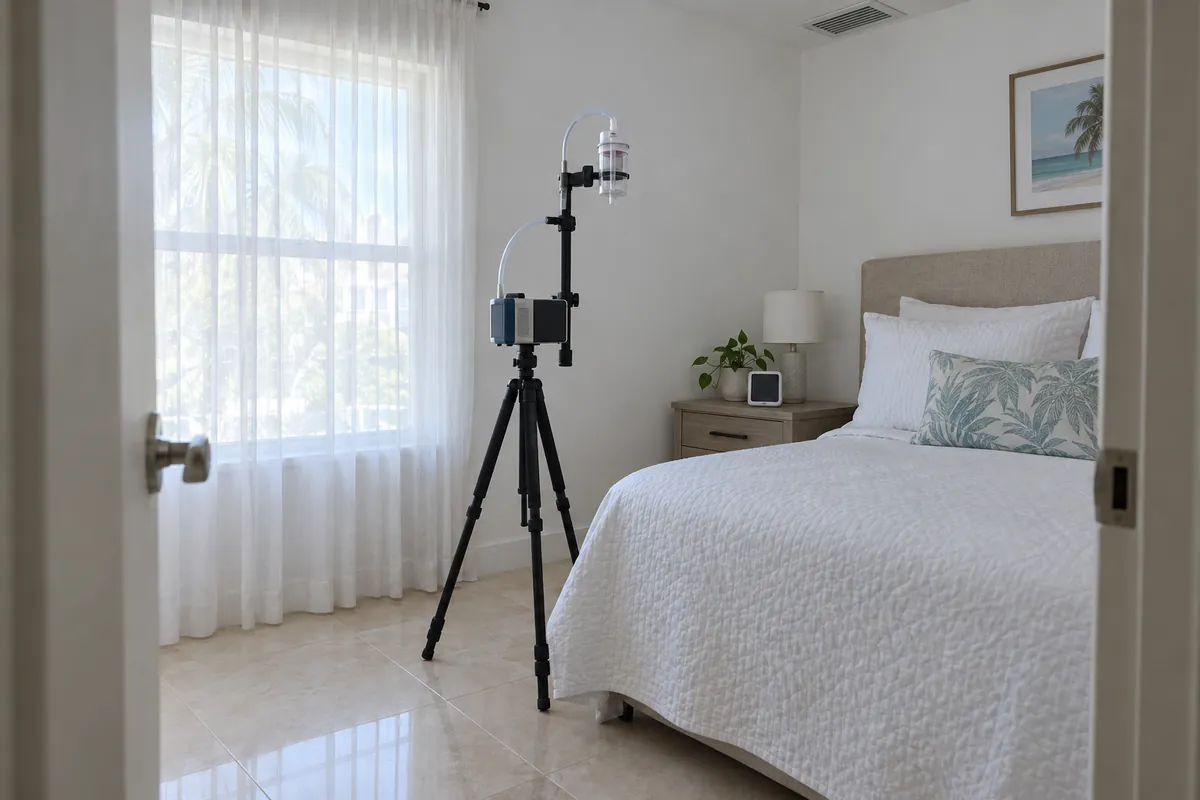
The core of an indoor air quality inspection is a comparison. We run a calibrated pump that pulls air through a sampling cassette at 15 liters per minute, so a ten-minute sample is 150 liters of air. We take at least one sample outdoors, usually near the front door, and one or more indoors in the rooms that matter. The cassettes go to an accredited lab, which identifies the spore types and counts them.
Outdoor air in Florida is never clean. There are always spores in it from landscaping, mulch, leaf litter and the general wet climate. That outdoor sample is the baseline. A healthy house looks like outdoors, only lower, because the filter and the closed envelope strip some of it out.
The indoor sample tells a story when it does one of two things:
- It is higher than outdoors. Spores do not multiply in the air. If there are more inside than outside, something inside is producing them.
- The mix is different. Some spore types are common outdoors and show up indoors in small numbers. Others are water-damage indicators that point to a material that stayed wet. When those show up indoors and not outdoors, that is a strong signal, even at modest counts.
We explain how to read those lab tables in How to Read Your Mold Inspection Report, so we will not repeat it here.
What the sample cannot tell you
This is the part that matters if you are trying to connect a house to how you feel.
- It cannot say a person's symptoms are caused by the house. The lab counts spores. It does not know who lives there or what they react to. Pet dander, dust mites, pollen tracked in on shoes and cleaning products are all outside the scope of a mold sample.
- It is a snapshot. Ten minutes on one afternoon. If the A/C was running hard, or a door was open, or the carpet was just vacuumed, the count moves. That is why we note the conditions and why we sample more than one room.
- It cannot locate the source by itself. A high count in the bedroom does not mean the mold is in the bedroom. It means the air that reaches the bedroom is carrying it. In a house with central air, that air came from the air handler.
So the sample is the starting point, not the conclusion. The inspection has to go find the source, and in our experience the walk-through usually ends at the same place.
The usual culprit: the air handler
Every room in a central-air home breathes through one box. The air handler pulls return air in, cools it across the evaporator coil, and pushes it back out through the supply ducts. The coil is wet whenever the system runs. That is how it dehumidifies. The condensate drips into a drain pan and out a drain line.
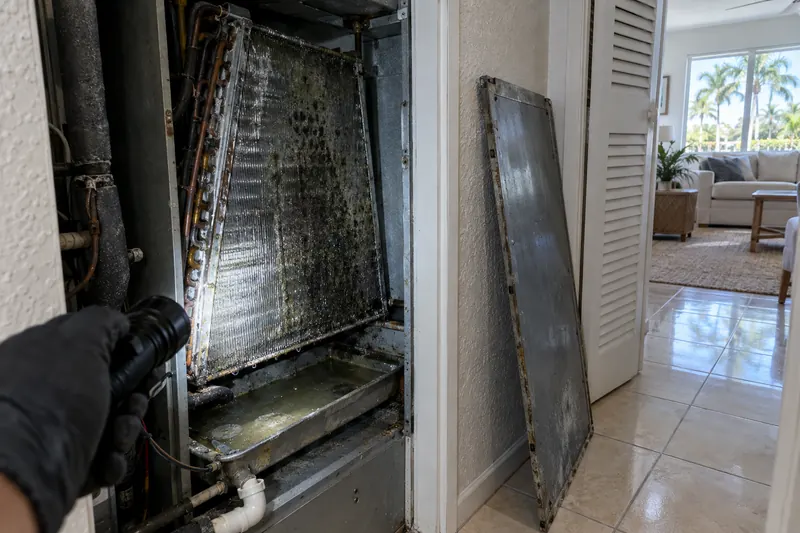
That box is a cold, damp, dark space with a steady supply of dust from the return air. If anything in it stays wet longer than it should, it grows. A common finding on inspections:
- A drain pan with standing water because the drain line is partially clogged with algae or sludge.
- A dirty coil with a film of growth on the fins and the insulation around it.
- Blower wheel blades coated in dark buildup.
- Growth on the inside of the supply plenum, the first section of duct after the unit, where the air is coldest and condensation forms on the metal.
- Flex duct joints that sweat because the insulation jacket is torn or the attic is hot and humid.
None of that is visible from the living room. The house looks clean. But every time the blower runs, it pulls air across that growth and delivers it to every supply register in the house. That is how a small problem in a closet becomes a whole-house air sample. We covered the visible warning signs in Is Your A/C Spreading Mold?.
There is also a quieter version of the problem. A system that is oversized, or set to a fan-on mode, or short-cycling, does not run long enough to pull moisture out of the air. The house feels cool but the humidity stays high. We find readings above 60% relative humidity in homes where the thermostat looks fine, and at that level the growth is not in the air handler at all. It is on the back of a closet wall, under a bed, or inside a bathroom cabinet. The air sample picks it up either way.
What we look at during the inspection
When someone tells us they feel better away from home, we treat it as a reason to look harder at the air system, not as a diagnosis. The visit usually includes:
- A hygrometer reading in several rooms, and a note of what the thermostat says versus what the air actually holds.
- Opening the air handler cabinet and inspecting the coil, pan, drain line, blower and insulation with a flashlight.
- Pulling the return filter and checking what it is catching and whether it fits the frame. A filter with a gap around the edge is letting unfiltered air straight to the coil. We recommend a MERV 8–11 pleated filter for most residential systems; anything higher can restrict airflow on a unit not designed for it.
- Looking at the first few feet of supply duct at the plenum, where condensation shows up first.
- A moisture meter on walls near the unit, around registers, and in any room the occupant flags.
- Air samples indoors and outdoors, and surface samples of anything that looks like growth so the lab can confirm what it is.
The report ties those together. Air counts without a source are a question. Air counts with a dirty coil, a wet plenum and a water-damage indicator species in the bedroom are an answer.
What to do with the result
If the air handler is the source, the fix is usually mechanical and specific: clear the drain, clean or replace the coil, replace the blower wheel if it cannot be cleaned, reseal or replace the plenum, and correct whatever let it stay wet. If there is growth on building materials, that is a remediation job with containment and HEPA air scrubbers. Under Florida law we cannot do that work on a property we assessed, and we will not refer you to anyone in particular. What we will give you is a written scope so whoever does it knows exactly what the lab found and where. Details on how that process works are at /mold-remediation/.
After the work, a clearance air sample, taken the same way, is how you know whether the house now matches outdoors again. That is the number we care about, and the one that answers the original question about the building.
If you have noticed the pattern and want the house checked, request an inspection or call 561-303-0130 in Palm Beach, 954-388-0218 in Broward, or 305-882-9490 in Miami-Dade.