
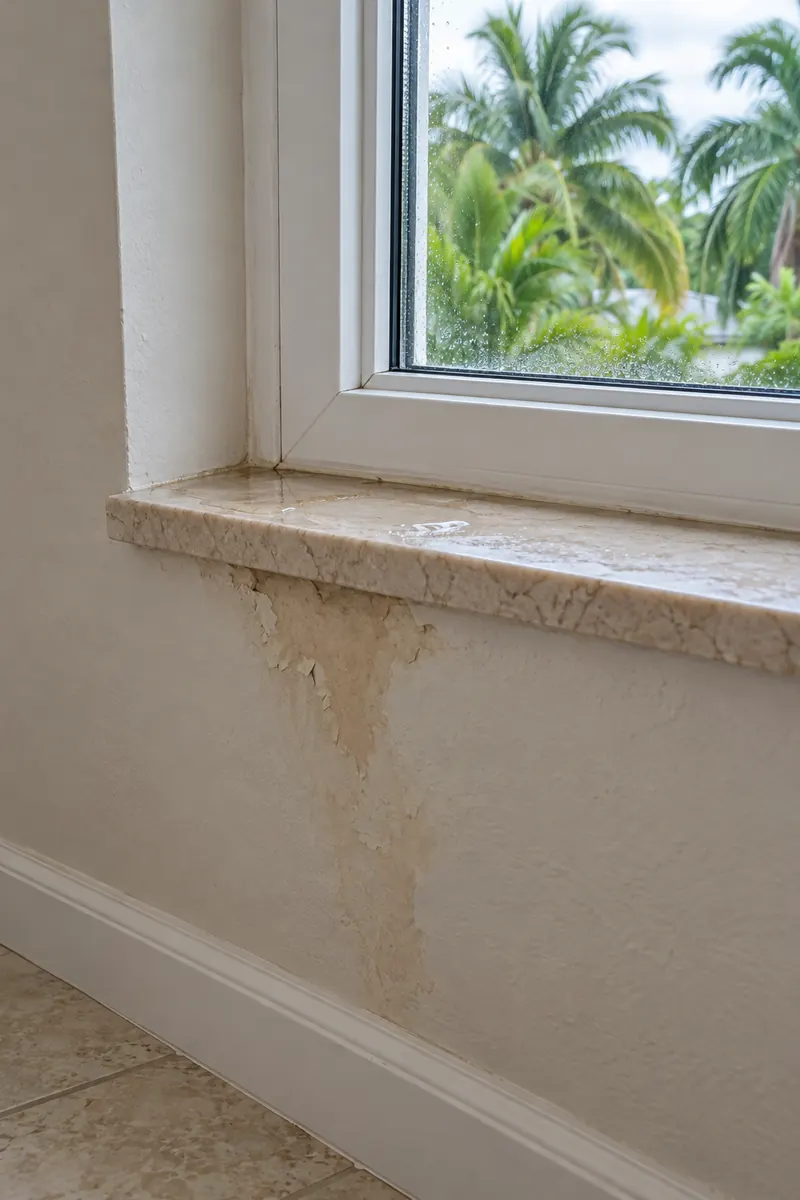
Start with when the sill gets wet
A wet window sill is a symptom, not a diagnosis. Water may collect on cold glass and run down onto the sill. Rain may enter around the frame. Water may also travel through the wall before appearing beneath the window.
We often see staining below a sill treated as a paint problem. Fresh paint can cover the mark without changing what is happening behind it. A dry sill during an inspection also does not establish that the surrounding wall stayed dry during the last storm.
Before wiping everything away, photograph the sill, lower frame corners, and wall below. Note whether the wetness followed rain, appeared during dry weather, or developed while the air conditioning was running. These observations help us decide where to check.
- Droplets across the room-facing glass suggest condensation deserves attention.
- Wetness that follows wind-driven rain points toward an exterior water-entry investigation.
- Peeling paint, swollen trim, or recurring marks below the sill suggest checking the wall, even when the window looks dry.
These are clues, not proof. Condensation and rain intrusion can occur at the same opening.
Condensation leaves a different trail
Condensation forms when humid air meets a surface cold enough for water to collect. At a window, we look for droplets on the glass or frame and a visible path down to the sill. We also check whether condensation is on the room side or outside. Exterior condensation alone does not establish an interior leak.
Inside a South Florida home, cold air directed toward the window, restricted air movement behind coverings, and humid air entering around an opening can contribute. We look at these conditions alongside indoor humidity rather than assuming the window needs replacement.
A useful distinction is whether moisture stays on the exposed surfaces or extends into the drywall below. Condensation can damage that drywall if water repeatedly runs over the sill edge. Finding wet drywall therefore does not automatically rule condensation out.
The correction should address the conditions producing the droplets and any resulting material damage. For the broader humidity issue, see our guide to indoor humidity. Here, the question is narrower: does the observed condensation explain the moisture pattern around this window?
Rain can enter around or beneath the frame
A sill pan is concealed flashing beneath the window assembly. Its job is to collect incidental water and direct it outside rather than into the wall. Missing, damaged, or poorly connected flashing can let water reach materials below the opening.
That does not mean a stain beneath a window proves the sill pan failed. Water entering higher up can travel down and collect in the same place. We inspect accessible frame joints, perimeter sealant, drainage openings, and the surrounding exterior before narrowing the explanation.
Stucco cracks near the frame are another potential route. We look for cracks at corners, separation where materials meet, and evidence that water has followed those areas. A visible crack deserves investigation, but its presence alone does not prove it reaches the interior. The drainage layers behind the stucco also matter.
A bead of caulk is not a diagnosis. Sealing the wrong joint may leave the actual entry route untouched or obstruct intended drainage. Concealed flashing may require controlled water testing or selective opening by a qualified contractor. In a condo, notify management before arranging exterior testing or repairs involving shared building components.
The camera finds patterns; the meter checks materials
A thermal camera shows surface temperature differences. It does not see mold, look through drywall, or directly measure water. A cooler patch below a window may be consistent with damp material, but air leakage, shading, and air-conditioning patterns can produce temperature differences too.
We use that image to guide moisture-meter checks. Readings around the sill, beneath the corners, and farther down the wall help map the affected area. We compare suspect locations with apparently dry areas of similar material rather than treating an isolated reading as an answer.
Metal corner reinforcement, fasteners, and other concealed materials can influence some meter readings. Material selection and instrument limitations matter. Where appropriate and authorized, pin measurements can help investigate a questionable surface reading.
Together, the tools show where further investigation is warranted. A moisture pattern concentrated beneath a lower corner after rain supports a different investigation from droplets spread across cold interior glass. Neither pattern, by itself, proves a concealed sill-pan defect.
Timing matters too. A wall checked after drying may no longer show elevated moisture. We document that limitation and consider photographs, staining, weather history, and whether follow-up testing during relevant conditions is needed.
Why the drywall swab can decide the sampling question
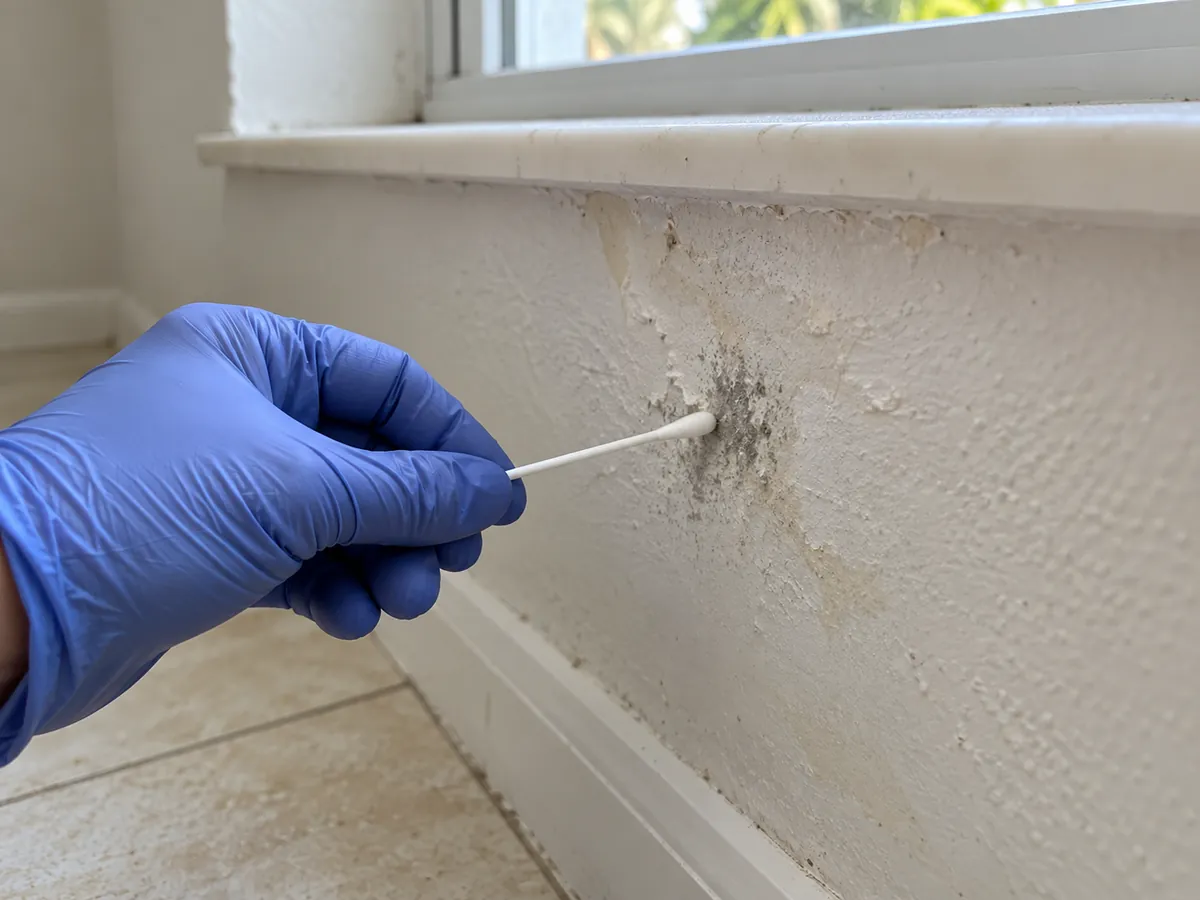
The drywall below the sill is where the water path and the material condition often meet. When discoloration there could be mold or ordinary staining, a targeted swab can provide evidence about the sampled surface. That makes it more directly relevant to that question than a room-air sample alone.
The assessor selects and documents the suspect location, collects the sample, and submits it for laboratory examination. Findings showing fungal structures consistent with growth can help resolve uncertainty about that patch. The interpretation belongs alongside the moisture findings and visual inspection.
The swab can help decide what the surface mark is; it cannot decide where the water entered. It does not establish the condition of the entire wall cavity or identify a failed sill pan. A negative result from the painted face also cannot rule out growth on concealed drywall paper.
Sampling is not automatically necessary when visible growth already makes the condition clear. Nor should repairs to wet materials wait for a sample result. If the unresolved question concerns the back of the drywall, an authorized selective opening may be more informative than another surface swab. Our guide to reading your inspection report explains how findings and limitations fit together.
Fix the water route before closing the wall
The next step should follow the evidence: correct condensation conditions, repair the confirmed exterior entry route, or investigate concealed flashing further. Document damaged materials and verify drying before repainting or closing an opened wall.
When mold remediation is needed, the assessment should define the affected area and recommended work. Under Florida law, a licensed assessor cannot remediate a property they assessed. Same Day Mold Inspections provides the building diagnostic; a separate qualified remediator performs the remediation.
For a recurring wet sill, request an inspection or call Palm Beach at 561-303-0130.